



The 44th edition of MCE concludes: focus on innovation, sustainability, and the HVAC+R market.
The 44th edition of MCE closes with solid results and a clear vision: innovation, sustainability and skills are driving the future of HVAC+R
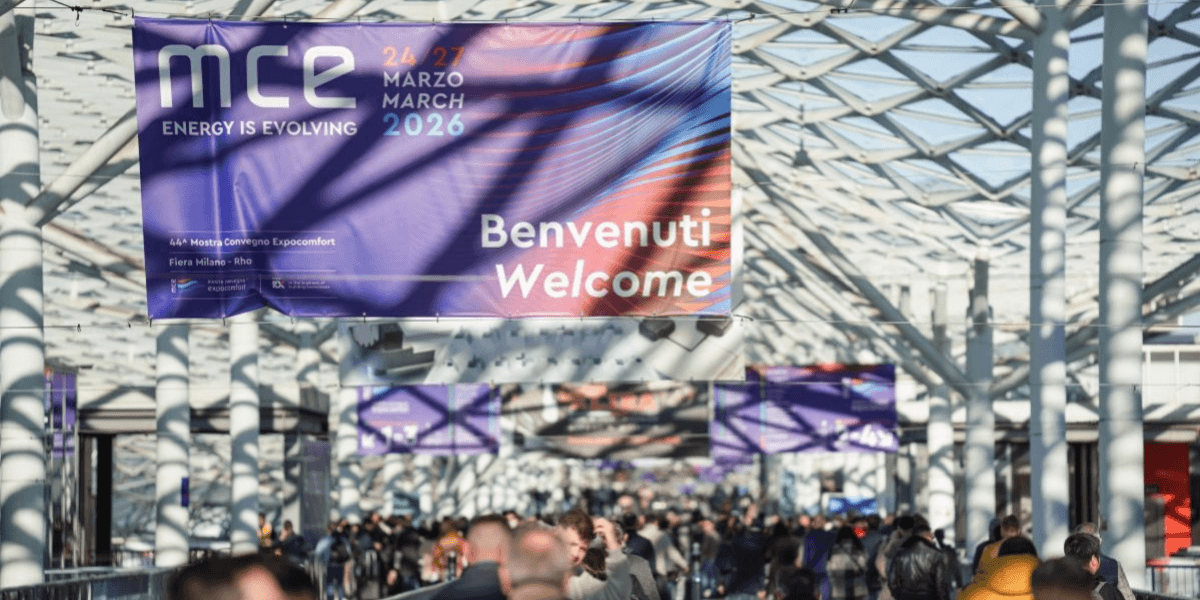
The 44th edition of MCE – Mostra Convegno Expocomfort 2026 concluded at Fiera Milano Rho, confirming its position as a key event for the world of HVAC+R, renewable energy, and water management.
With 1,600 exhibitors and over 120,000 visitors, more than 35% of whom came from abroad, the event confirmed its role as a strategic international platform for discussion between industry, design, and installation.
A context where technology, market, and relationships intertwine, offering a concrete vision of the evolution underway in the sector.
From decarbonization to digitalization: the technologies that are redefining the sector
The 2026 edition highlighted a sector increasingly oriented towards high-efficiency and low environmental impact solutions.
From heat pumps to the digitalization of systems , up to integration with smart systems and building automation , MCE has shown how innovation is now an essential lever for addressing current energy challenges.
An evolution that involves the entire sector ecosystem. As Massimiliano Pierini , Managing Director of RX Italy, emphasized, "MCE confirms its position as an international platform capable of interpreting and supporting market changes, which are increasingly focused on energy efficiency, sustainability, and system integration."
Beyond the Exhibition: The Strategic Value of Direct Interaction between Companies and Professionals
Beyond numbers and technologies, MCE confirms itself above all as a meeting place .
For designers and installers, the fair represents a concrete opportunity to interact directly with manufacturers, explore technical solutions, and build relationships that will help them develop their business.
In this context, another key aspect emerges: the growing importance of skills . Massimiliano Pierini also highlighted how "in a rapidly evolving scenario, the contribution of the entire supply chain and the development of new skills to manage increasingly complex and integrated systems are becoming essential."
New skills for new systems: how the work of designers and installers is changing
The signals that emerged during the event confirm a now consolidated trend: the HVAC+R sector is evolving rapidly , driven by regulations, technological innovation and new energy needs.
For industry professionals, this means constantly updating their skills and design approaches, integrating increasingly efficient systems, connected solutions, and sustainability considerations.
Between innovation and the market: why MCE remains a privileged observatory on the future of comfort
The closing of MCE 2026 leaves a clear message : the sector is undergoing a full transformation and the ability to innovate will be crucial to remaining competitive.
With ever-evolving technologies, new energy models, and a growing focus on sustainability, the Milanese event confirms its position as a privileged observatory for understanding the future of comfort.
An event that, once again, demonstrated how value lies not only in the solutions presented, but in the connections and opportunities that arise during the fair.
FAQ
This edition highlighted a strong acceleration in the adoption of integrated solutions based on heat pumps, hybrid systems, and system digitalization. During the design phase, this means prioritizing flexible system architectures, designed for integration with renewables (photovoltaic and storage) and advanced control systems (BMS). Selecting components compatible with demand-response logic and continuous performance monitoring becomes crucial.
The main critical issues concern evolving regulations on refrigerants (F-Gas and PFAS restrictions), rising energy costs, and the need to reduce Scope 1 and 2 emissions. This pushes the trend toward natural refrigerants (CO₂, propane) and high-efficiency solutions. However, design challenges arise related to safety, installer training, and the adaptation of existing infrastructure, especially for retrofits.
Sustainability is no longer just a regulatory requirement but a design driver: the focus is on low-emission systems throughout their life cycle (LCA), with a focus on seasonal efficiency, predictive maintenance, and durability. Innovation translates into modular solutions, plug-and-play systems, and greater integration between HVAC, ventilation, and indoor air quality (IAQ), with direct impacts on the design of nZEB buildings and advanced energy retrofits.
