From flow to control: how Bini Clima's CT and CC cassettes adapt to HVAC projects
A range of hydronic cassettes that can be configured to integrate performance, silence, regulation and ease of installation in different types of buildings
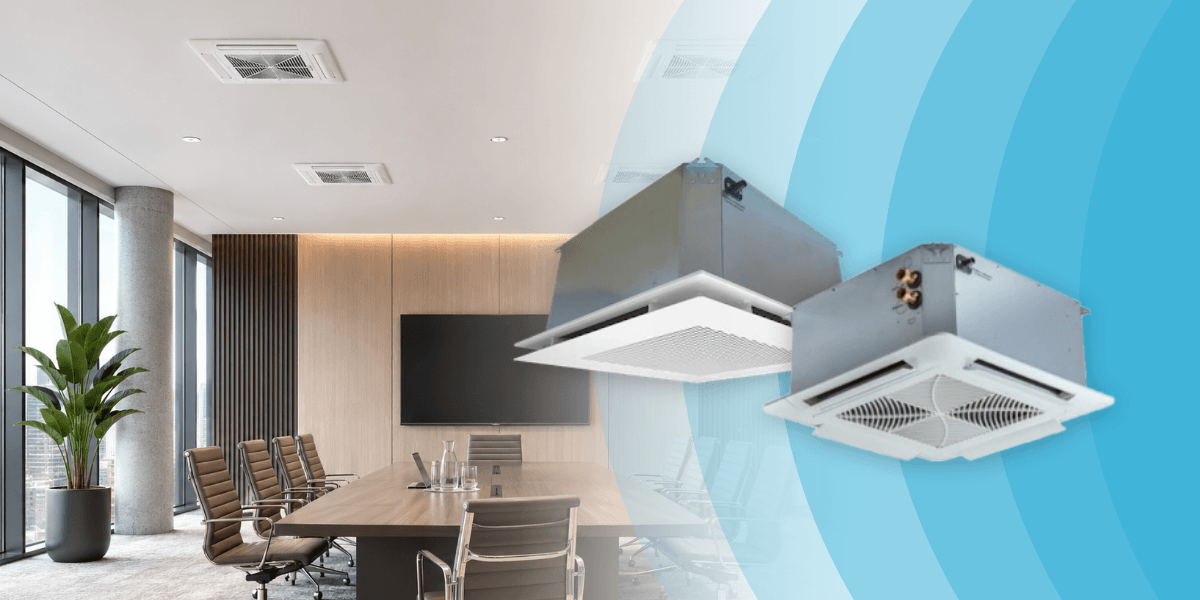
When designing a hydronic system, the choice of terminal unit cannot depend solely on the required power. Air flow rate, diffusion mode, noise level, integration with the suspended ceiling, and control logic all contribute to determining the system's actual behavior, especially when rooms have variable loads and different usage conditions throughout the day.
Bini Clima's CT, CT-EC, CC, and CC-EC water cassettes were developed specifically to offer designers multiple configuration options within a single product family. The range includes standard models and versions with Coanda effect diffusion, multi-speed AC or modulating EC motors, single and double configurations, and coils for 2- or 4-pipe systems. This modular structure allows the terminal to be adapted to the building's characteristics, rather than imposing an identical solution on vastly different contexts.
A range designed for different distribution logics
The CT and CT-EC series feature a RAL 9003 white ABS diffuser panel, with a central intake grille and side vents with adjustable louvers. This configuration allows the air flow to be directed according to the geometry of the space, the occupants' layout, and the presence of architectural or furnishing elements.
The CC and CC-EC series instead use a metal panel with four-sided diffusion, designed to make the air flow adhere to the ceiling by exploiting the Coanda effect. This allows the air to travel a greater distance before descending into the occupied area, promoting more gradual diffusion, especially during cooling. The difference between CT and CC therefore does not only concern the aesthetic appearance of the panel, but represents a real design choice regarding the air emission method .
The availability of single and double cassettes also allows for the coverage of spaces with varying sizes and needs. The chassis and panels are compatible with standard European false ceiling modules, while the technical documentation specifies a maximum installation height of 3.5 meters, thus limiting the risk of hot air stratification during heating operation.
Flow rate and capacity are not fixed values, but design variables
The range includes different flow and power levels, allowing you to select the terminal based on the actual room load. In models with AC motors, the maximum nominal flow rate varies approximately from 580 to 1,510 m³/h , while in EC versions it can reach 1,620 m³/h , with the option of progressively reducing the flow through the control signal.
Thermal capacities also cover a wide range. Based on the nominal data reported in the technical data sheet, the total cooling capacity of the various configurations ranges from approximately 3.10 to 13.98 kW , while the heating capacity can exceed 15 kW in the larger models. The range can therefore be used both in single rooms and in larger spaces or those with higher thermal loads, maintaining the option of choosing between 2- and 4-pipe systems.
This variety becomes particularly important in buildings where different environments operate differently. A hotel room, a meeting room, an open-plan office, or a public area can have very different occupancies, internal inputs, and usage times. Correctly sizing the cassette therefore means avoiding both undersized terminals, forced to constantly operate at maximum speed, and oversized units that could generate discontinuous operating cycles and less stable comfort management.
AC or EC motor: two different regulation strategies
The CT and CC boxes can be equipped with a three-speed AC fan motor , a solution suitable for systems requiring simple and reliable control. The external rotor motor uses a balanced radial impeller with backward-curved ABS blades and is available with IP21 protection.
The CT-EC and CC-EC variants instead adopt an electronically commutated motor with an integrated circuit board and regulation via a 2-10 Vdc signal. The fan speed can therefore be modulated progressively, adapting the flow rate to the actual demand of the room. In the nominal data of the EC range, the sound pressure level can drop to 22 dB(A) at the minimum regulation conditions indicated, confirming the importance of partial load operation in managing acoustic comfort.
Modulation isn't just used to reduce fan speed. It helps avoid sudden changes in airflow, maintain a more stable temperature, and adapt the terminal to changes in occupancy or thermal load. This becomes important in hotels, offices, and public buildings, where the system often operates for long hours and under conditions far from the maximum design load.
The range of controls and accessories further expands management options. In addition to wall-mounted thermostats and the optional infrared remote control, the range can be combined with touch controllers with Wi-Fi connectivity, master/slave modules, and controls compatible with protocols such as Modbus and BACnet . The terminal can therefore be integrated into both relatively simple stand-alone systems and centralized systems where supervision and control must communicate with the building management system.
The hydronic circuit as an element of flexibility
The coils are made of copper tubes and high-efficiency aluminum fins with a hydrophilic treatment. The 2-pipe configurations can be used for either cooling or heating, while the 4-pipe versions allow for separate management of the two circuits, should the boiler and chiller operate separately.
Installation and maintenance considered from the design stage
A terminal's performance must be matched by practical management throughout its entire life cycle. The Bini Clima cassette structure is made of galvanized sheet metal with 8 mm fireproof and sound-absorbing insulation , used to limit condensation, corrosion, and noise transmission.
The central grille can be opened to access the internal components, while the filter is removable for easy cleaning. There is also an opening on the side of the unit for external air intake, allowing the terminal to be integrated into more complex system configurations.
The condensate drain unit includes a centrifugal pump combined with an electromechanical float switch, with an alarm contact in the event of a blockage. The range can be completed with valve kits, auxiliary trays, flanges for primary air intake or for treating adjacent rooms, antibacterial filters, sound attenuation systems, and additional control accessories.
The configuration can therefore be set following some specific design priorities:
- CT, when adjustable diffusion through directional fins is desired;
- CC , when the distribution along the ceiling and the Coanda effect represent central elements of the project;
- AC motor , for systems with discrete speed management;
- EC motor , for modulating regulation and greater integration with control systems;
- 2-pipe system , for buildings with centralized seasonal switching;
- 4-pipe system , when it is necessary to manage hydronic circuits separately.
A terminal to be configured around the building
Bini Clima's CT and CC cassette units are suitable for residential, hotel, office, and public spaces. These are diverse applications, but they all share the same need to integrate the terminal into the false ceiling, control noise, and distribute air without compromising user comfort.
The value of the range lies precisely in the ability to compose the solution based on the project: standard or Coanda effect diffusion, AC or EC motor, 2- or 4-pipe system, single or double unit, and different control systems. The cassette is thus not considered an isolated component, but rather a terminal designed to interact with the architecture, hydronic circuit, regulation, and usage of the rooms.
Because comfort does not depend only on the available power, but on the ability of the entire system to deliver it when, in the way and in the quantity actually needed.
Bini Clima Srl