



EU Tripartite Contracts: Clean Energy for Industry, with Stability and Investment
The EU introduces tripartite contracts between the public sector, green producers and industry to incentivise offshore wind, grid and storage, ensuring clean energy, certain investments and competitiveness.
The European Commission has launched the first tripartite contracts for affordable energy , an innovative tool designed to involve governments, clean energy producers, and large industrial consumers. This scheme, included in the recent Affordable Energy Action Plan, aims to ensure affordable prices, secure demand, and sustained investment. The first sectors to be involved will be offshore wind , electricity grids , and energy storage . The goal is to break down barriers to renewable energy adoption, improve industrial competitiveness, and support industry in the transition.
A new three-way energy system: what changes?
Tripartite contracts introduce a shared model between three actors: the public sector (including governments and financial institutions such as the EIB), clean energy producers, and industrial consumers. This formula should ensure greater visibility and stability for investments in renewables, thanks to the certainty of an offtake by industry and public political and financial support. The EU aims to structure these mechanisms for specific sectors, with initial application in offshore wind , grid infrastructure , and storage systems, key sectors for the integration of solar and wind.
Why it's needed: to reduce costs and boost competitiveness
In the current European context, industries are complaining about high energy costs and market instability. Tripartite contracts aim to balance renewable supply and demand, enabling industry to purchase at certain prices and supporting suppliers with a guaranteed market. According to Dan Jørgensen, EU Energy Commissioner, they are a foundation for increasing competitiveness, economic resilience, and energy security . Furthermore, up to €130 billion in annual savings on fossil fuels by 2030 are estimated if the Affordable Energy Plan is fully implemented.
Opportunities and warnings for those who plan and invest
For professionals in the energy and plant sectors, tripartite contracts represent a strategic guideline for planning large-scale projects , reducing significant market risk, and obtaining more secure financing on better terms . However, some stakeholders point out that the model also entails potential burdens for consumers or taxpayers , should the cost of the transition be passed on to end users. Furthermore, the most energy-intensive sectors—such as steel—stress that they remain tied to the marginalist electricity pricing mechanism, which limits effective decarbonization.
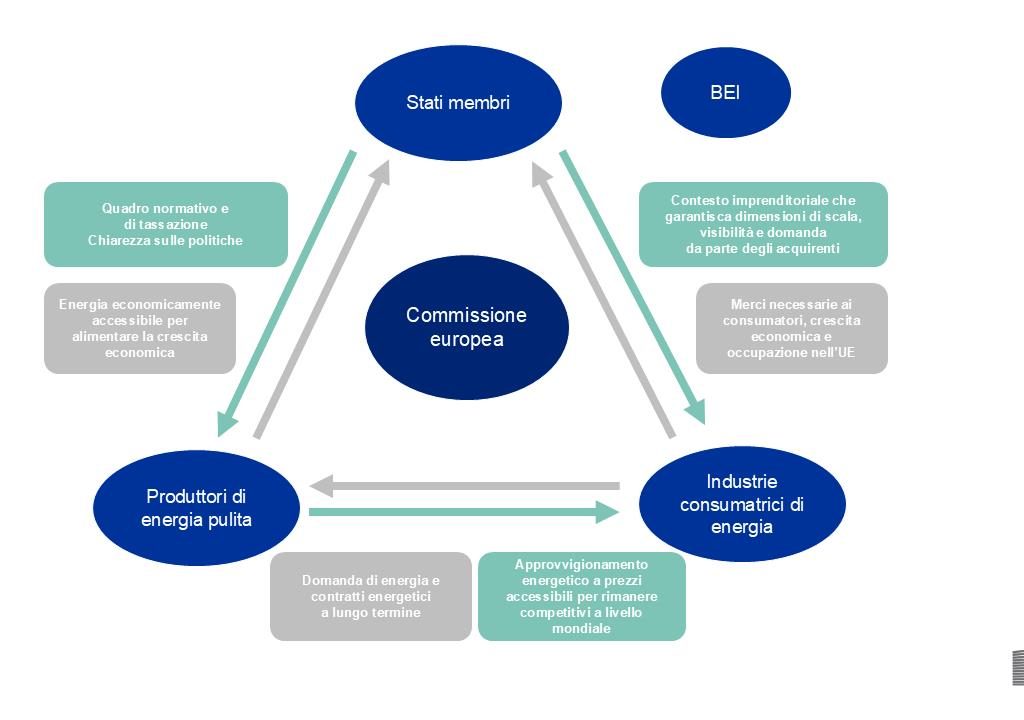
Image source: rinnovabili.it
A look to the future: from theory to implementation
Preliminary work is defining the first sectoral agreements, starting with offshore wind, networks, and storage . This approach is aligned with the Clean Industrial Deal and the European Green Deal and could become a model for other sectors such as biomass, energy efficiency, and hydrogen . The first concrete test will come from industry summits scheduled for early 2026 (e.g., the Hamburg Summit), where a "New Deal for Offshore Wind" could be formalized. Success will depend on the ability to ensure transparency, fairness, and financial sustainability in cost management.
