
A-Gas and the management of exhausted refrigerants: with Rapid Exchange, end-of-life gas becomes a resource
With Rapid Exchange, A-Gas supports HVAC-R installers and maintenance technicians in the sustainable, traceable and valorisable management of exhausted refrigerants
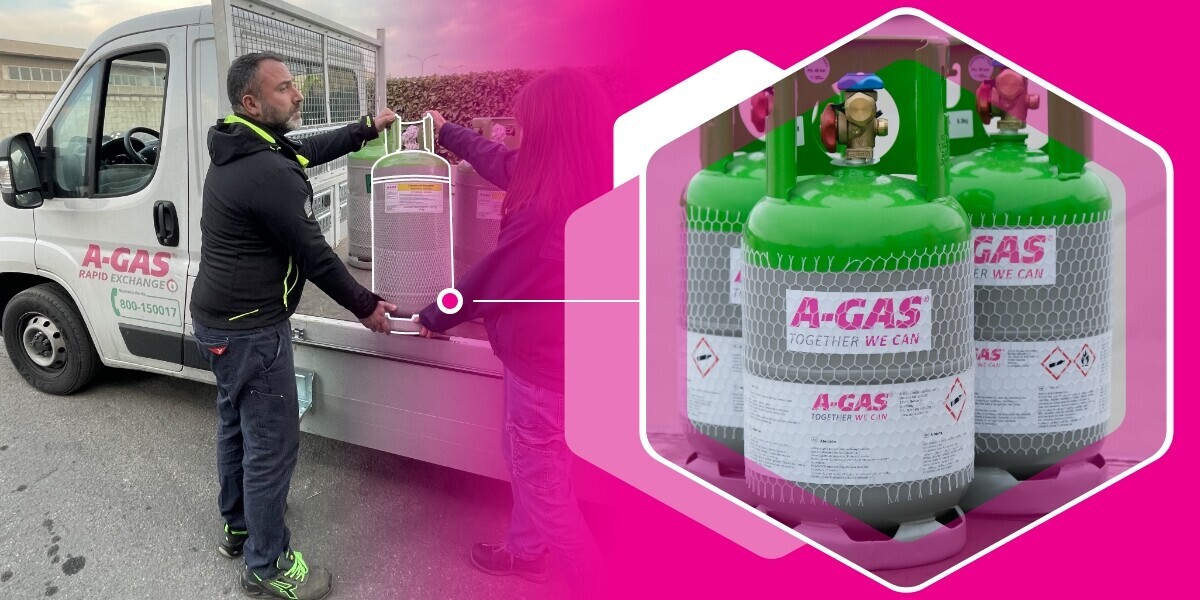
With the arrival of spring and summer, the cooling season approaches, and the HVAC-R sector enters a phase of intense activity : in anticipation of rising temperatures, the demand for new installations, scheduled maintenance, retrofits, and replacements increases. A central aspect of the business is the management of used refrigerants, characterized by high climate-altering potential, which must be treated with a view to increasing sustainability and circularity.
From gas recovery to valorization: why used refrigerant can become a resource
Gases recovered during plant maintenance or replacement are classified as hazardous waste and, as such, are subject to stringent requirements regarding collection, traceability, and final destination. Their management falls within the scope of the European Regulation on Fluorinated Gases (F-Gases), which aims to reduce their use and, consequently, reduce the release of CO2 emissions into the atmosphere.
Especially for small and medium-sized installers, the correct management of even limited quantities of these gases often represents a logistical and administrative complexity, with costs and timeframes that are difficult to sustain.
To address these critical issues, A-Gas, a global leader in sustainable refrigerant lifecycle management (LRM), has developed the Rapid Exchange service: an approach that transforms used refrigerant into a recoverable, regenerable, and even economically valuable resource.
Rapid Exchange: How A-Gas Simplifies the Management of Recovered Refrigerants
Rapid Exchange is based on a simple operating model: the installer collects the end-of-life refrigerant in cylinders specially provided by A-Gas, while a specialized team from the company collects them directly from the customer's premises, replacing the full cylinders with empty containers ready for use.
During this collection phase, the customer can request an initial analysis of the cylinder contents : this service is primarily used when the composition of the delivered product is unclear, in order to determine its type and degree of purity. Once the refrigerant's characteristics have been identified, A-Gas technicians can provide the customer with immediate feedback, including a price estimate in line with market prices.
The service also includes customer assistance in managing all necessary documentation, ensuring regulatory compliance and traceability throughout the supply chain.
From regeneration to controlled destruction: the correct destination of recovered gases
Once collected, used refrigerant can follow two paths . When technically possible, A-Gas regenerates it through advanced purification processes , bringing it back to standards equivalent to virgin product, according to international specifications (AHRI 700). When regeneration is not possible, the product is sent for controlled destruction using certified technologies, permanently eliminating its emission potential.
Both options contribute to the reduction of climate-altering emissions, but regeneration allows the gas to be reintroduced into the production cycle, in accordance with the principles of the circular economy.
Recycled and reclaimed refrigerant: differences, limitations, and reusability
In this context, it is also important to distinguish between gas recycling and regeneration , in order to understand all the advantages of a correct recovery process.
In the first case, the recycled refrigerant can only be reused within the same system from which it was extracted. Any reuse in other systems is possible only in compliance with the provisions of the EN 378 technical standard and requires full traceability of the history of the system and the gas itself. The operator performing these recycling operations assumes a direct role in product management, with responsibility for labeling and associated technical documentation.
Without these procedures, refrigerant recovered from existing plants and not managed properly could potentially contribute to the volume of illegal products on the market, as well as increasing the risk of uncontrolled releases into the atmosphere.
Conversely, reclaimed refrigerant can be reused in different systems , ensuring full operational safety, circularity, and traceability. Structured services like Rapid Exchange therefore support the HVAC-R sector in promoting compliant and sustainable practices, including at an economic level.
Rapid Exchange for small and medium-sized installers: a solution even for small quantities
“Rapid Exchange has been active in Italy for several years and represents concrete support for installers, for whom the management of used refrigerant involves critical issues related to classification, logistics and documentation requirements,” explains Matteo Mangiarotti, Head of Rapid Recovery Italy at A-Gas .
The service is specifically designed to manage even small volumes, which are often difficult for small and medium-sized businesses to process efficiently, resulting in the risk of backlogs or suboptimal disposal. "Rapid Exchange is a micro-collection system capable of managing a large number of operations across the country," adds Matteo Mangiarotti.
Thanks to its widespread logistics network, the company is increasingly present throughout Italy: "Solutions like Rapid Exchange represent a concrete tool to support businesses, especially small and medium-sized ones, which can outsource part of the management complexity," concludes Enzo D'Alessio, Commercial Director and General Manager of A-Gas Italia. "In the context of the ecological transition, refrigerant gas management is no longer just a regulatory requirement, but is becoming an operational lever, impacting sustainability, efficiency, and competitiveness."
For more information on the Rapid Exchange service, you can contact A-Gas by filling out the form below or contact them directly at [email protected]
A-Gas Italia