When comfort is truly felt: air distribution and the Coanda effect in air conditioning
Indoor comfort depends not only on temperature, but also on how air is distributed throughout the rooms. An in-depth look at the role of the Coanda effect and ceiling cassettes in professional air conditioning.
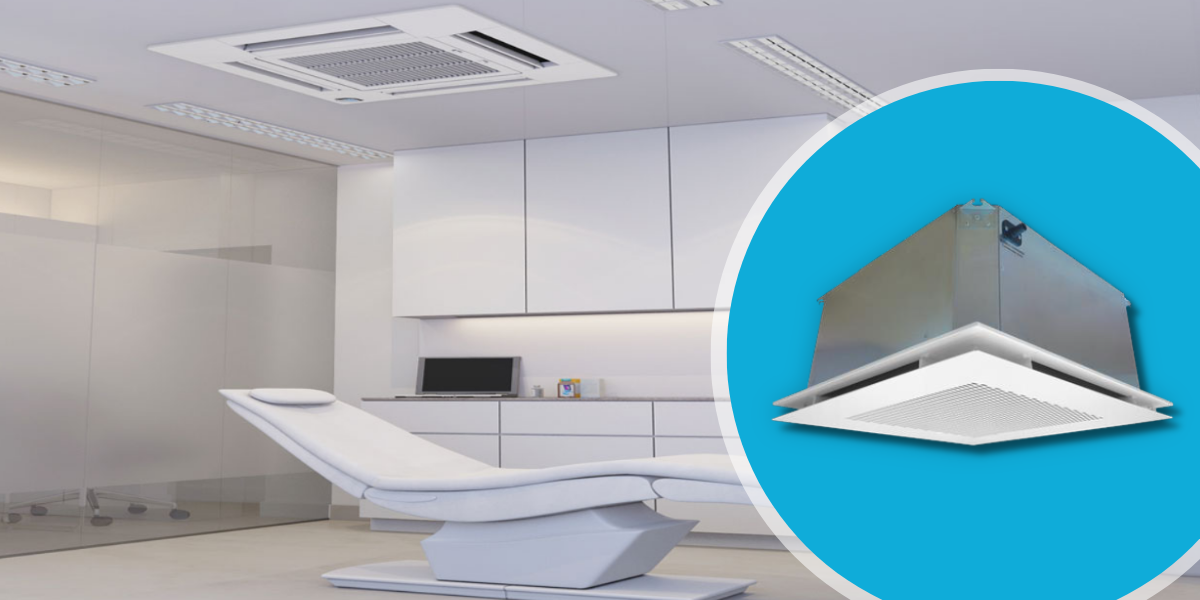
Entering a space and immediately feeling at ease isn't just a matter of the number on the thermostat. It's often a more subtle sensation: the air isn't hitting you directly, the temperature is uniform, and there are no "cold" spots or heat buildup. It's in these details that true indoor comfort lies, especially in professional spaces.
In modern HVAC design , the way air is distributed has become as central as energy efficiency or installed capacity. And this is precisely where seemingly "traditional" solutions, such as ceiling cassettes , can make a difference if designed with advanced logic.
When air distribution makes the difference in comfort
Two rooms can be set to the same temperature and still feel completely different . The difference lies not so much in the thermostat setting, but in the air dynamics : excessively direct airflow, stratification, and imbalances between the upper and lower zones significantly impact perceived well-being. In offices, hospitality facilities, commercial, or healthcare spaces, these critical issues become even more evident, especially with medium-high ceilings, variable thermal loads, and inconsistent occupancy.
In these contexts, simply increasing the flow rate or power of the terminal is not enough. Air distribution becomes a true design choice: a well-controlled flow allows air to diffuse gradually throughout the space, reducing the direct impact on people and promoting a more uniform temperature in the actual living area. The terminal is therefore not just an intake point, but a tool that contributes to defining the overall quality of the space, with effects that are noticeable over time in the continuity of comfort and the sense of balance within the environment.
The Coanda effect and comfort in occupied spaces
One of the physical principles that enable more effective air distribution is the Coanda effect, the tendency of airflow to adhere to a nearby surface and follow its contours rather than abruptly detaching from it. Applied to air conditioning, this phenomenon allows air to flow along the ceiling, gradually slowing down, and gradually mixing with the ambient air. The result is a softer, more controlled diffusion, which reduces direct drafts, limits stratification—especially in cooling—and helps maintain a more uniform temperature in the occupied area.
When air distribution is designed to exploit the Coanda effect, comfort becomes more stable and continuous, even under partial loads or with changes in space usage. The air's impact on people is significantly reduced, improving the quality of experience in environments such as offices, hospitality facilities, and public spaces, where indoor well-being directly impacts the perception of space and productivity.
The role of Bini Clima cassettes in comfort management
This is where Bini Clima's water cassettes come in, designed to control the airflow in a way that's consistent with the room's needs. The configuration of the vents, the orientation of the jets, and the ability to adapt to different system solutions allow you to maximize the benefits of the Coanda effect, transforming air diffusion into a true comfort factor.
More than just a terminal, the cassette thus becomes an integral part of the air conditioning strategy , helping to create balanced environments in both cooling and heating.
From technical design to the daily experience of spaces
When air distribution is considered from the earliest design stages, comfort isn't something measured simply with instruments, but something you experience every day. It's a constant sensation, accompanying those who use the spaces without being noticed, because it works.
Solutions capable of intelligently managing air movement, exploiting principles such as the Coanda effect, today represent a concrete ally for those designing HVAC systems oriented not only to performance, but also to the actual quality of indoor comfort.
Bini Clima Srl