Battery Storage Systems: Advanced Thermal Management from ebm-papst for Reliable and Efficient BESS
ebm-papst solutions for advanced thermal management of BESS, designed to ensure efficiency, safety and operational continuity in storage systems
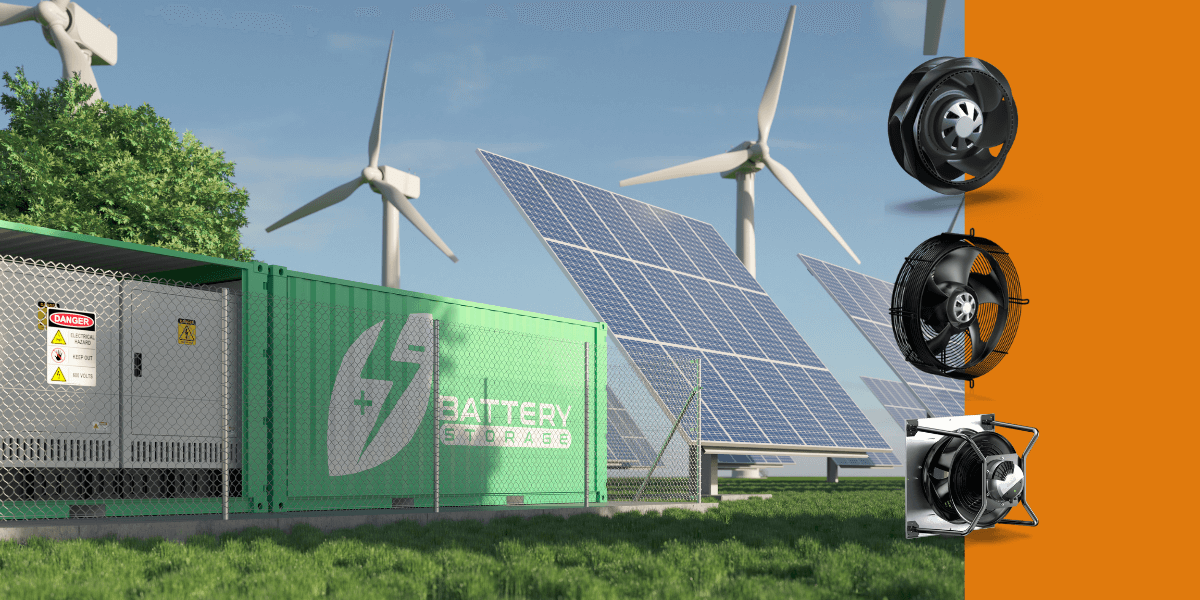
The growth of renewable energy and the need to stabilize energy production are accelerating the adoption of Battery Energy Storage Systems (BESS). These systems allow for the storage of excess energy produced, ensuring availability when the grid or facilities require it.
One of the factors that most determines the safety, continuity, and operational life of a BESS is thermal management . ebm-papst solutions, based on highly efficient EC technologies, address this need with advanced temperature control and an integrated approach to protecting the most sensitive electronic components .
Why Thermal Management is Crucial in Energy Storage
In storage systems, each charge and discharge cycle generates heat , which can directly impact battery performance and reliability. High temperatures accelerate aging, reduce storage capacity, and increase the risk of critical phenomena such as thermal runaway. Added to this is the heat produced by bidirectional converters, inverters, and the electrical panels that control the energy flow.
An effective heat dissipation strategy is therefore not just a support, but a structural element in the design of a BESS. Ensuring internal climate stability means protecting the entire hardware ecosystem that allows the system to operate safely and continuously.
.png)
The ebm-papst technological approach: intelligent ventilation and dynamic control
ebm-papst applies decades of experience in air movement and electromechanical design to BESSs . EC fans are the heart of this offering: high-efficiency motors, integrated control electronics, and optimized aerodynamic profiles enable high air flow rates with low energy consumption and reduced noise.
EC technology also allows for extremely precise speed regulation , adapting ventilation to real-time conditions. This ensures not only stable temperature maintenance, but also intelligent use of the system's energy resources, reducing operating costs and thermal stress on components.
Air and liquid solutions for any scale BESS configurations
Depending on the power and size of the storage system, ebm-papst offers two main approaches to thermal management.
Liquid cooling is ideal for large energy containers or high-energy density applications: the heat transfer fluid quickly absorbs heat from the cells and transfers it to the exchanger, where it is dissipated with the help of high-performance fans. This process ensures stability even in extreme environmental conditions.
Air cooling , on the other hand, is the preferred solution for scalable and modular systems due to its ease of integration, lower costs, and the ability of EC fans to accurately modulate flow rate based on operational needs. In both cases, the goal is to keep the entire BESS within a safe temperature range, preserving capacity, lifespan, and reliability.
Critical Component Protection and Business Continuity: The Added Value of ebm-papst
An efficient storage system isn't just about protecting the batteries: inverters, electrical panels, conversion systems, and safety devices also require constant and predictable cooling . ebm-papst develops solutions designed to ensure thermal stability at every critical point of the system, reducing the risk of overheating and improving operational continuity.
For particularly sensitive applications, such as those in potentially explosive atmospheres or in containers integrating fire protection systems, solutions designed for smoke removal and ventilation in hazardous areas are also available. In this way, ebm-papst offers not only technical components, but a complete ecosystem for the safety and long-term reliability of BESS, fostering the evolution of energy storage systems towards ever higher standards of efficiency and sustainability.
Ebmpapst Srl